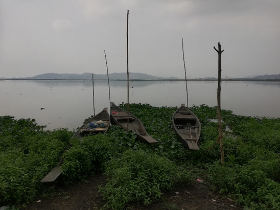
There were a few boats anchored on the shore, covered with water hyacinths. It was difficult to say where these hyacinths came from, but they had been carried to the shore by the gentle wind. The ripples caused by the wind also made the boats dance.
Fishermen come to the Beel at dawn and fish for 10 to 12 hours. They return in the evening after catching enough fish to sustain themselves for the next day. Sata Das, who is among the hundreds of fishermen of Deepor Beel, has no other means of livelihood than fishing. He says, “we are ‘মাছৰ চিকাৰী’ (fish hunters). The fish understand our sorrows. If they do not get caught in our nets, then what will happen to us?”
The Beel takes care of the needs of every species around it. But as human greed has increased, the Beel has begun to experience exploitation. Deepor Beel is vanishing. Wetland life is becoming fragile. As I reached the site of Deepor Beel, I saw a large number of tiny birds flying rapidly just over the water’s surface. These birds feed on insects found in polluted areas, and their population is growing alarmingly.
A crane caught my attention as I was enjoying the Beel from a distance. It appeared in search of food, its wings spread wide, and its legs extended forward, preparing to land safely on the boat. After ensuring that there was no one nearby, it stepped forward slowly and silently, looking into the boat to see if there were any fish. It kept checking if anyone was coming by, lifting its head from time to time. It was cautious.
It walked along the entire length of the boat, only to be disappointed after finding no fish either on the boat or in the water. It stood at the edge of the boat where it had landed and waited.
Perhaps it wanted to rest for a while before continuing its search. It seemed to know the Beel. The Beel is kind. Perhaps it also knew that by dusk, the Beel would provide for it.
The white bird paused for a few moments before gently flapping its wide wings, not even stirring the breeze. I watched it one last time as it disappeared, its wings steady as if it were a still object.
The scene returned to what it had been before, with no trace of the crane’s presence. I sat there for a while, feeling more enchanted by the Beel than before.
Author’s note
This piece is written as part of an exploration of the many perspectives on the alarmingly shrinking Deepor Beel, entangled in complex ways. Several visits to the Beel made me reflect on the interrelationships between the Beel and its surroundings, and how this balance is now being threatened. It is also an attempt to be mindful of the minute details of nature and how small creatures share this space in harmony.
Author’s Bio
Ankita Hazarika is an avid reader and researcher. Her interests lie in the interrelationship between nature and the human economy. She is an Assistant Professor of Economics at Bikali College, Gauhati University.
Banner Image Credit: The author