When I asked about the meaning of the shawl, Sindhe Wadakka from Khajuri village, now in her fifties and the president of the Niyamgiri Dangaria Kondh Weavers Association, said quietly, “It is our identity. Kondh people come together with threads of different colors joining.” Her words were simple, but they stayed with me. In the villages spread across the slopes of the Niyamgiri Hills in Odisha, Kapdganda is a shawl that Dangaria women weave and wear over their short saris. It carries the earth, the forest, and Niyamgiri, the dangar, which the Dangarias speak of as mother, father, and protector.
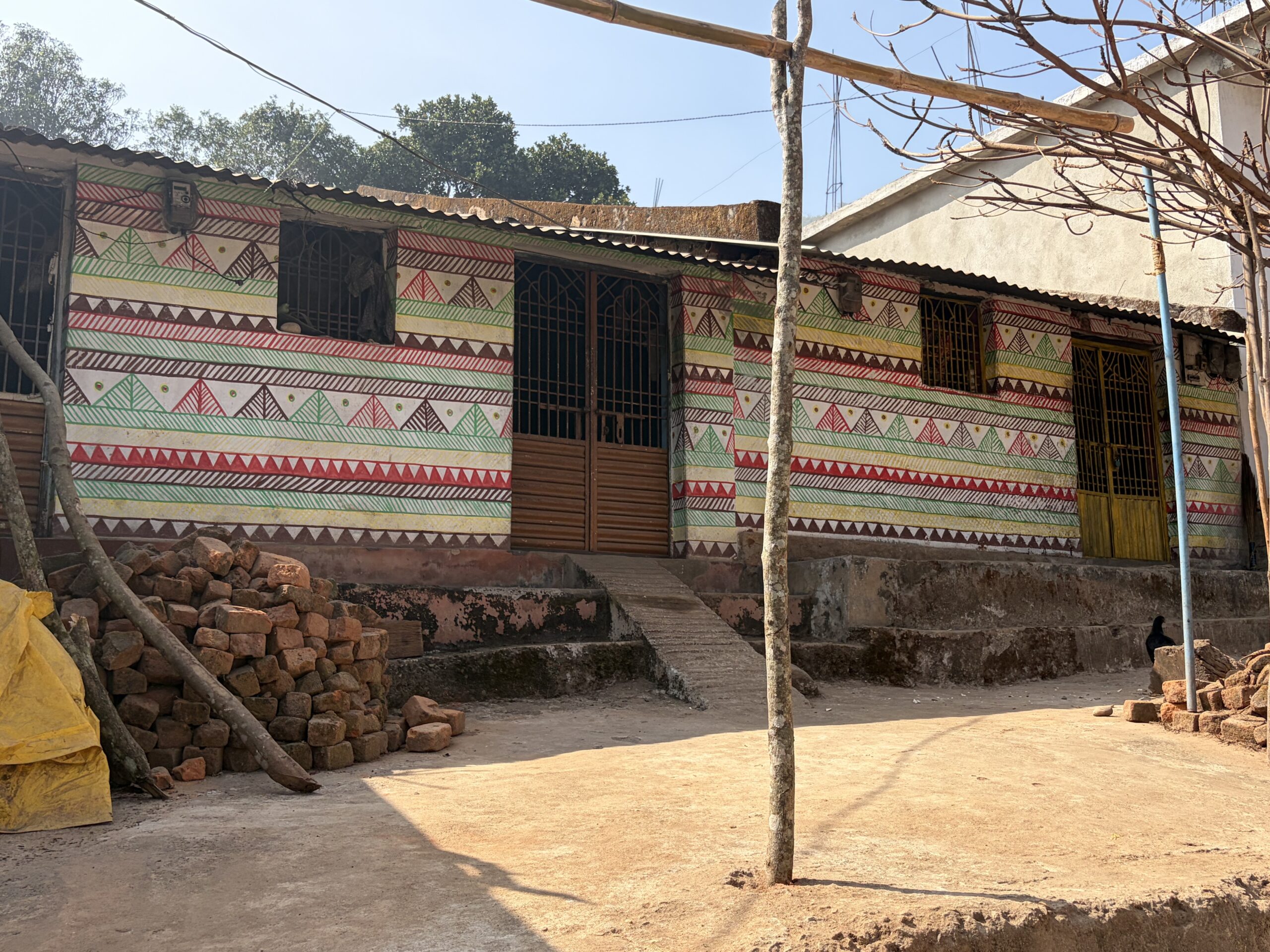
Women spend three to four months, sometimes up to a year, completing a single shawl. Every morning, as Sindhe explained, they walk to the dangar to cultivate and gather. “Because of the dangar, we get the rain, and our harvest is plenty,” she said. The same dangar appears again in the embroidery— as triangles—and also on the mud walls of their homes.
In the Kuvi language, Kapdganda means “chief’s cloth,” yet its making rests entirely in women’s hands.
The shawls are thick, handwoven white or off-white cotton, filled slowly with bright threads of green, red, yellow, and brown. Each color is tied to the surrounding world: green from hills and crops, red from ragi and other millets, yellow from turmeric grown in abundance, and brown from the soil itself. Earlier, natural dyes were used; now the threads are mostly bought from the market. Nevertheless, the meanings associated with color have not changed.
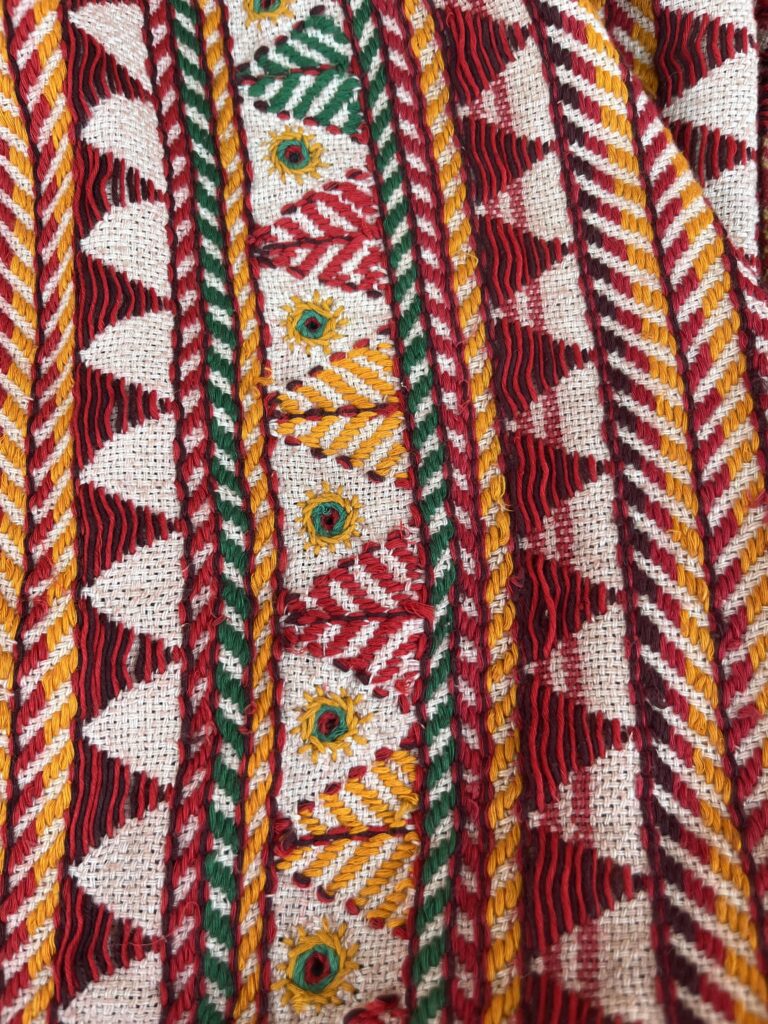
In Khambesi and Khajuri villages, I observed young and older women sitting together on their porches, a small basket of thread beside them, working on shawls nearly two by five feet.
The embroidery begins by entangling thread in a marked area of the cloth and then slowly extending the pattern. These shawls are made for themselves, for brothers, and sometimes for an intimate partner.
Some young women who have completed schooling continue to engage in this work. One girl told me, “I have completed class ten. I do what my mother does, go to the jungle and weave.” Yet there is also hesitation among the younger generation. Sindhe worries that many no longer follow rituals or feel tied to the dangar, their divine. Out of nearly six hundred people in her village, she said, only twenty to twenty-five women continue embroidery. Ramesh Nala, a community resource person, echoed this concern, noting that girls now seek education or wage work because embroidery yields very little income. Due to mining and resource extraction, there is massive unemployment in the region. It has led to a large-scale migration of young people to the cities in search of menial jobs. The young women who are left behind find embroidery time-consuming and low-paying, so they may not be committed to making it.
Traditionally, both weaving and embroidery were done within the community. The yarn for the shawl was bought in the local market, and the weavers, both men and women, would weave using the pit loom locally known as tanta. The pit loom is one of the earliest types of horizontal looms made of wood. Manually operated, it gets its name from the pit over which it is set—four wooden posts sunk into the ground holding the loom in place. The weaver sits at ground level and operates it with their feet on the treadles located inside the pit. It remains common in traditional weaver communities across Odisha. Today, plain shawls often come from neighboring regions, and Dangaria women focus on embroidery. Government agencies now provide needles, thread, and base fabric; organize training for young women, and a completed shawl earns approximately 2,000 rupees (approx. 20 USD). Pituli Sikkaka from Khambesi told me that if she worked full-time, she could finish one in three months. Women do the embroidery only after completing cultivation, gathering firewood, cooking, and caring for the family.
During my visit, I attempted to lift a bundle of firewood onto my head with the assistance of three women. I could not remain steady. Every day, the women walk uphill a few kilometers to work in the jungle and on their way back, they collect heavy bundles of dry firewood from the forest. Their daily labor—walking long distances uphill, working in fields, and still finding time to embroider—revealed the depth of effort contained within each shawl.
Kapdganda is a spiritual and cultural symbol of the Dangarias. It is shaped by women’s time, movement, and endurance. On 4th January 2024, Kapdganda, the Dangaria weave of Niyamgiri received the nationally approved Geographical Indications (GI) tag, recognizing its originality tied to the region, the unique handwoven contributions of Dangaria women, and protecting it from commercial duplication. With the GI tag and the training of young women, the Niyamgiri Dangaria Kondh Weavers Association continues its work as a way of connecting with the dangar, the land, and the forest, which are being destroyed through mining.
In the slow stitching of Dangaria women, identity itself is being held together, thread by thread.
Author Bio
Annapurna Devi Pandey is an anthropologist at the University of California, Santa Cruz.
Banner Image Credits: The author.